STATION1 / COLLABORATIVE RESEARCH / ONGOING MODELING
The energy
behind AI.
Energy & Environmental Impact of AI Data Centers
Modeling Electricity Demand of Data Centers Using the Global Change Analysis Model
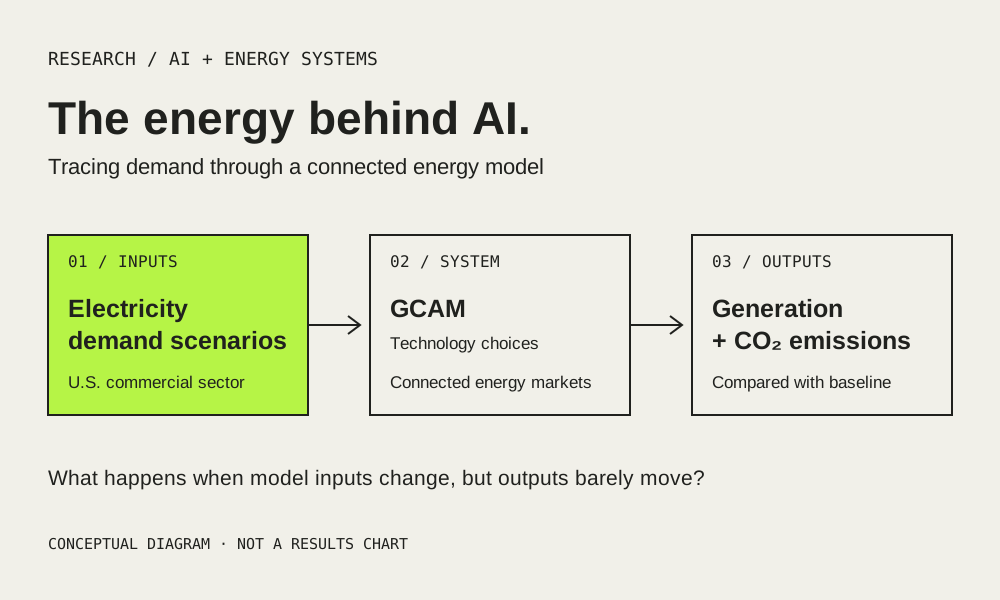
01 / The question
Can an integrated assessment model meaningfully represent the electricity demand associated with expanding AI data centers? Our study explores whether changes to GCAM’s existing electricity and commercial-building systems produce observable changes in U.S. electricity generation and carbon emissions.
In the configuration we studied, data centers were not represented as a distinct sector. That made the mapping itself a central research problem: how should a rapidly growing, electricity-intensive activity be represented within a broader calibrated energy system?
02 / What we tested
We compared a reference scenario with several interventions, using the paper’s long-term research question through 2050 while inspecting model outputs extending to 2100.
- Electricity input coefficients. We multiplied electricity-related energy-input coefficients by three in the U.S. electricity configuration. These coefficients describe energy input per unit of electricity output; changing them is not equivalent to directly tripling electricity demand.
- Commercial service demand. We adjusted the “commercial others” base-service parameter from 2025 onward, relative to the 2021 calibrated value. The scenario increased to approximately 15% above that value by 2050, then held the multiplier constant.
- Technology sensitivity. We also tested changes to electricity technology share-weights, technology costs, and scenario-specific XML inputs to examine how parameter changes propagated through the model.
THE CENTRAL OBSERVATION
Changed inputs.
Nearly unchanged outputs.
The paper reports that model diagnostics accepted the interventions, but aggregate electricity generation and CO₂ emissions remained nearly identical to the reference scenario in the tested cases.
This is a finding about these modeling experiments—not evidence that AI data centers have no environmental impact.
03 / Interpreting the result
The unexpected lack of response made parameter tracing and model sensitivity the focus of the investigation. Potential explanations include calibration effects, interactions across sectors, and substitutions among electricity-generation technologies. The experiments described in the paper do not establish which mechanism caused the limited response.
The manuscript also describes rising atmospheric CO₂ concentration alongside declining or leveling regional emissions. Concentration reflects cumulative global emissions; it should not be treated as a direct measure of one regional intervention’s effect.
04 / Limits & next questions
This is exploratory, ongoing modeling work. These scenarios do not yet provide a validated forecast of AI-specific electricity demand or emissions through 2050. The original figures and underlying numerical outputs are not included on this page; the illustration above explains the workflow only.
- Trace changes from configuration inputs through service demand, generation, and emissions.
- Calibrate near-term demand trajectories before extending scenarios to 2050.
- Explore an explicit data center subsector with cooling, geography, and facility-type distinctions.
- Compare efficiency improvements and policy scenarios, including clean energy requirements and carbon pricing.
05 / Research team
Gia Henville, Aiden Tom, Nigel Tatem, Frances Lu, Wasif Khan, Jesus Medina, Christine Ortiz, Jingjie Yeo, and Ellan Spero.
Collaborative research through Station1. Gia’s listed affiliation in the supplied manuscript is Western Governors University.
This overview summarizes the manuscript supplied by Gia Henville. It presents the study as collaborative work and does not assign individual contributions or imply peer-reviewed publication.